
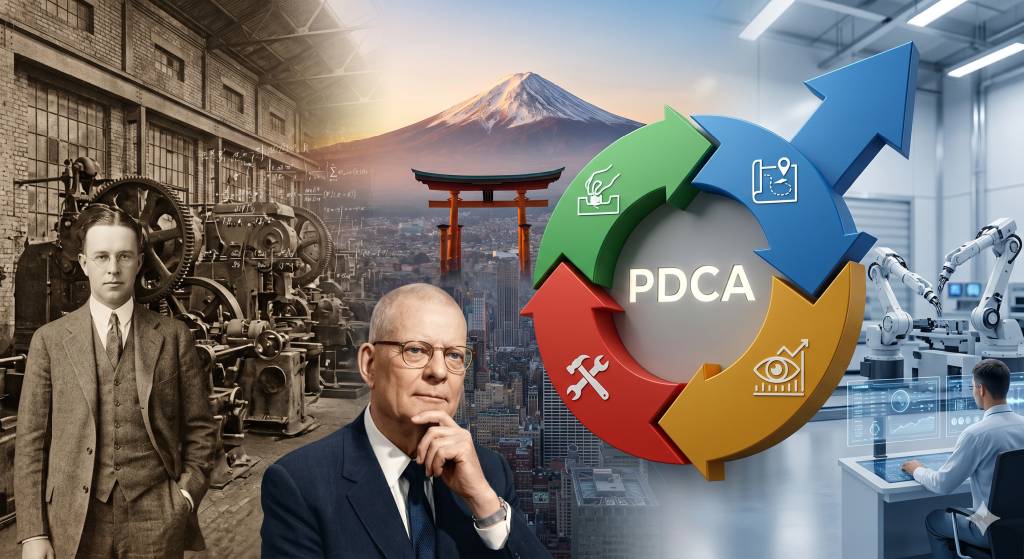
The Paradox of Popularity
The acronym PDCA (Plan-Do-Check-Act) has become one of the most ubiquitous marks in the global corporate vocabulary. Few organizations, at some point in their governance or process improvement journeys, have not turned to the famous four-quadrant circular diagram. Yet this very popularity conceals an uncomfortable paradox: PDCA has become so universal a symbol that it risks being constantly stripped of its conceptual weight — reduced to a mere visual checklist or a purely operational execution tool.
When treated only as a sequence of “plan, do, check, and act,” the cycle loses its most valuable foundation: that of a scientific method adapted to solving complex problems and generating organizational knowledge. This practical reductionism ignores the fact that PDCA was not born as a managerial task guide, but as a rigorous, mathematically grounded response to one of the greatest industrial challenges in modern history: variability.
This article sets out to recover the conceptual depth behind the cycle, tracing its roots in physics, statistics, and American philosophical pragmatism. By understanding the transition between the original model formulated by Walter Shewhart and the modifications proposed by W. Edwards Deming, contemporary leaders and managers can move beyond mechanical application and use the framework as a genuine engine of continuous learning and institutional resilience.
Walter Shewhart and the Problem of Variability
To understand the birth of the cycle, it is necessary to go back to the 1920s, in the laboratories of Bell Telephone and the factories of Western Electric in the United States. The context was one of industrialization at an unprecedented scale, where the manufacture of complex telephone equipment demanded a degree of standardization and parts interchangeability that the engineering tools of the era could barely sustain.
It was in this environment that physicist, engineer, and statistician Walter A. Shewhart identified that the great enemy of productivity and quality was not a lack of operational effort, but rather the inherent variability of processes. Shewhart understood that no human or mechanical process produces two absolutely identical outputs. From this observation, he established an ontological distinction that would transform management science: the difference between variation from common causes and variation from special causes.
- Common Causes (or Random Causes): These are the forces that are part of the system’s own design. They are present at all times, affect all operators, and result from the complex interaction of stable variables (machinery, standard raw materials, environment). A process exhibiting only common causes is considered statistically stable and predictable.
- Special Causes (or Assignable Causes): These are isolated, intermittent anomalies external to the regular process design (a sudden machine breakdown, a defective batch of raw materials, a gross operator error). They remove the system from a state of statistical control.
Shewhart’s revolutionary insight was recognizing that intervening in a process without understanding the type of variation present produced what he called tampering — which, rather than correcting the problem, further increased the system’s instability. To guide engineers in the scientific investigation and correct intervention of these processes, Shewhart structured a three-step linear cycle in his classic 1939 book, “Statistical Method from the Viewpoint of Quality Control.” This model became known as the PDS (Plan–Do–See) cycle.
The Philosophical Foundation of Shewhart’s Cycle: Contrary to what many believe, the original cycle was not born from traditional engineering, but from the scientific method and American philosophical pragmatism — strongly influenced by philosopher John Dewey (particularly his work “How We Think”) and epistemologist C.I. Lewis. Shewhart viewed industrial production as a permanent laboratory. “Plan” represented the formulation of a theoretical hypothesis; “Do” was the execution of a controlled experiment; and “See” corresponded to the empirical observation and testing of results against theory. It was an instrument of scientific learning, not bureaucratic execution.
Deming in Japan: The Transformation of a Cycle
In 1950, in a Japan devastated by the aftermath of war and with an industrial infrastructure in ruins, JUSE (the Union of Japanese Scientists and Engineers) invited American statistician W. Edwards Deming — who had been a close student and collaborator of Shewhart — to deliver a series of lectures on Statistical Quality Control to the country’s senior executives and engineers.
The Japanese context proved to be the ideal fertile ground for the deep absorption of these ideas. With a severe scarcity of resources, Japanese companies could not afford to waste raw materials or generate scrap through traditional end-of-line inspection. They needed to learn to get it right the first time. Deming presented Shewhart’s cycle as a continuous process of design, production, sales, and market research, illustrating it as a dynamic spiral aimed at quality improvement.
Japanese engineers and executives synthesized Deming’s lectures and adapted the original linear model, transforming it into the four-step cycle we know today: PDCA (Plan-Do-Check-Act). The term “See” was replaced by “Check” (verifying alignment with goals), and “Act” was added (taking corrective actions or standardizing success).
However, this translation generated deep dissatisfaction in Deming. In the following decades, he realized that the word “Check” was distorting the true intent of the scientific method. In the English language and in Western managerial practice, “Check” carried a strong connotation of inspection, constraint, or a simple binary verification (right/wrong, yes/no). In his later consulting work and books — such as “Out of the Crisis” (1986) and “The New Economics” (1993) — Deming fervently insisted on renaming the cycle PDSA (Plan-Do-Study-Act).
In advocating for the replacement of “Check” with “Study,” Deming was not engaged in a merely semantic battle. He argued that the purpose of the third phase is not simply to find out whether a target was met, but to understand the underlying reasons behind the result obtained. “Study” requires the organization to analyze the difference between what was predicted in the planning phase and what actually occurred during execution — transforming deviation into accumulated knowledge.
PDCA vs. PDSA: A Difference That Matters
The divergence between the PDCA and PDSA perspectives exposes two fundamentally distinct corporate philosophies. Although the acronyms are used interchangeably in many modern settings, understanding their differences in orientation is critical for leaders seeking to build a high-performance culture of continuous improvement.
| Dimension | PDCA Approach (Compliance Focus) | PDSA Approach (Learning Focus) |
|---|---|---|
| Primary Objective | Ensure compliance with standards and verify achievement of predefined numerical targets. | Build deep knowledge of the system and test the validity of managerial hypotheses. |
| Stance in Phase 3 | Check (Verify): Binary comparison between the expected target and the actual result obtained. | Study (Analyze): Root-cause analysis of variation and understanding of system behavior. |
| Treatment of Deviation | Viewed as an operational failure or error requiring immediate correction by the executor. | Viewed as a symptom of process design and a rich source of data for organizational learning. |
| Team Profile | Mechanical executors who fill out checklists and follow instructions strictly. | Practical scientists who formulate theories, run tests, and document findings. |
The practical implications of this distinction are evident in teams’ day-to-day routines. An organization that applies the cycle in a strictly mechanical manner (conventional PDCA) tends to punish or conceal deviations when the “Check” phase points to a negative result. The focus is on “fixing the indicator” so it returns to green on the control dashboard.
A team oriented by the spirit of PDSA, on the other hand, welcomes a negative result in the “Study” phase with the same scientific interest as a positive one. If the target was not met, the question is not “who made the mistake?” but rather: “What flaw in our theory about the process caused this discrepancy?” The failure of a hypothesis is, in itself, an advance in business knowledge — preventing the organization from repeating the same mistake strategically in the future.
The PDCA Cycle Within the Quality Eras
The cycle’s longevity stems from its capacity to function not as a static tool of a specific industrial era, but as a meta-structure of thought that traverses the different phases of quality management evolution — assuming distinct levels of complexity according to the maturity of each period.
The Inspection Era (Taylorism/Fordism)
In this initial phase, the focus was on the finished product. Quality was synonymous with sorting: separating good parts from defective ones at the end of the assembly line. PDCA was virtually nonexistent at the operational level — “Plan” was concentrated in the minds of methods engineers, “Do” fell to the alienated worker, and “Check” was limited to the inspector who discarded scrap. There was no systematic feedback loop for learning.
The Statistical Quality Control Era (SQC)
Inaugurated by Shewhart’s control charts, quality shifted from product to process. The cycle found its first true home: statistical methods were used to monitor variability in real time. “Check” became scientific, making it possible to identify whether a process was in control (common causes) or out of control (special causes), generating assertive action plans.
The Quality Assurance Era
With the expansion of global supply chains and the emergence of ISO 9000 standards, the focus shifted from the isolated process to organizational systems. The cycle expanded its scope: “Plan” came to encompass the full mapping of macro-processes, quality policies, and documented procedures; “Act” assumed the role of systemic auditing and implementation of global preventive actions.
The Total Quality Management Era (TQM)
TQM elevated the cycle to the status of a broad cultural philosophy, integrating all areas (from marketing to human resources) and all individuals (from senior leadership to the shop floor). Under the lens of TQM and the Japanese concept of Kaizen, PDCA ceased to be a project with a start and end date and became the daily metabolic rhythm of the organization. The cycle operates simultaneously at multiple levels: macro-cycles of strategic planning and micro-cycles of daily operational improvement.
Application: What the PDCA Cycle Requires to Work
Despite its apparent structural simplicity, effective execution of the cycle places rigorous demands on leadership and organizational culture. Most failures in implementing the cycle do not stem from technical deficiencies in the tool itself, but from classic behavioral and methodological deviations.
The Most Common Organizational Mistakes
- PDCA as a Bureaucratic Checklist: This occurs when teams fill out forms solely to satisfy audit requirements or governance rituals, with no critical reflection on the effectiveness of the planned actions.
- Operational Hyperactivity (The Jump from P to D): This is the most frequent deviation. Teams eager for results spend little time analyzing data and investigating root causes in the “Plan” phase and move directly to “Do,” acting by trial and error — generating rework and superficial solutions.
- Atrophy of the Analysis Phase (The Premature Finish Line): Many organizations execute “Plan” and “Do,” but close the cycle as soon as actions are implemented. Without completing the “Check/Study” phase, the learning obtained is not recorded and the knowledge is lost — condemning the organization to repeat the same mistakes in future cycles.
The Vital Relationship Between PDCA, SDCA, and Standardization
A continuous improvement cycle cannot sustain its gains without being anchored in a solid foundation of standardization. This is where the symbiotic connection between the PDCA cycle (oriented toward improvement and innovation) and the SDCA (Standardize-Do-Check-Act) cycle (oriented toward process stabilization and maintenance) resides.
The Act phase is the moment when the knowledge generated by the cycle is institutionalized. If the test carried out in the previous phase proved successful, leadership should not merely celebrate — it must rewrite Standard Operating Procedures (SOPs), retrain the workforce, and protect the system against regression.
Without the standardization that comes from “Act,” improvement resembles a wheel climbing a steep ramp: as soon as operational pressure ceases, the wheel rolls back to the bottom. The standard is the wedge that holds the wheel at the top, allowing the next PDCA cycle to begin from a higher baseline.
Conclusion
More than a management method or a visual artifact for managerial reports, the PDCA/PDSA cycle is an epistemological framework for thinking. It shapes the human mind and corporate culture to operate under the logic of healthy skepticism, empirical experimentation, and respect for facts and data — as opposed to mere hierarchical assumption.
Understanding its historical origins in Shewhart’s struggle against statistical variation, as well as Deming’s unwavering defense of the analytical character of “Study,” frees organizations from the trap of blind compliance. It enables the transformation of business routine into a dynamic environment where every problem ceases to be a punishable crisis and becomes a structured opportunity for scientific advancement.
To apply the cycle in practice, the site provides a PDCA cycle tracking tool, with phase-level date control and individual record export.