For David Garvin, in his work Managing Quality, the evolution of quality was not merely technical, but a shift in the nature of organizational responsibility. When we analyze the First Era — the Era of Inspection — from this perspective, we stop seeing only a measurement technique and begin to recognize the birth of quality as a formal management function.
The Rise of Inspection: Quality as Detection and Filtering
The history of modern quality begins with a drastic separation: the transition from craftsmanship to mass production in the 19th and early 20th centuries. This separation required quality to shift from being a “creator’s instinct” to becoming a “verification task.”
The Logic of Detection (Problem-Solving)
Unlike later eras, in which quality was seen as a strategic advantage, during the Era of Inspection it was viewed purely as a problem to be solved.
In this phase, the logic was reactive. Production took place on a large scale, and inspection functioned as a “sieve” at the end of the line. The reasoning was binary: is the product within specifications or outside them?
Focus: Error detection (not prevention).
Tools: Gauges, rulers, and visual tests.
Concept of Quality: Conformance to fixed technical standards.
The Institutionalization of Inspection (The 1922 Milestone)
A crucial point of this period was the emergence of the Quality Department. Previously, the inspector reported to the foreman or the production manager (which created conflicts of interest, since the goal was volume).
With the publication of The Control of Quality in Manufacturing by G. S. Radford in 1922, inspection gained autonomy. For the first time:
- Quality became an independent function.
- The inspector gained the authority to “stop the line” or reject batches, acting as a technical gatekeeper.
- Quality became linked to Engineering, separating “planning” from “execution.”
The Economic Dilemma of the First Era
Garvin argues that the Era of Inspection was inherently inefficient from a cost standpoint. By focusing only on the finished product, industry accepted waste as part of the process.
“Inspection does not improve quality; it only separates what is bad.”
In this model, the cost of poor quality was extremely high, including:
- Scrap: Materials completely lost.
- Rework: Extra labor hours to fix what was poorly made.
- Labor: Armies of inspectors who added no direct value to the product, only verification.
The Limit of the Model: The Rise of Variability
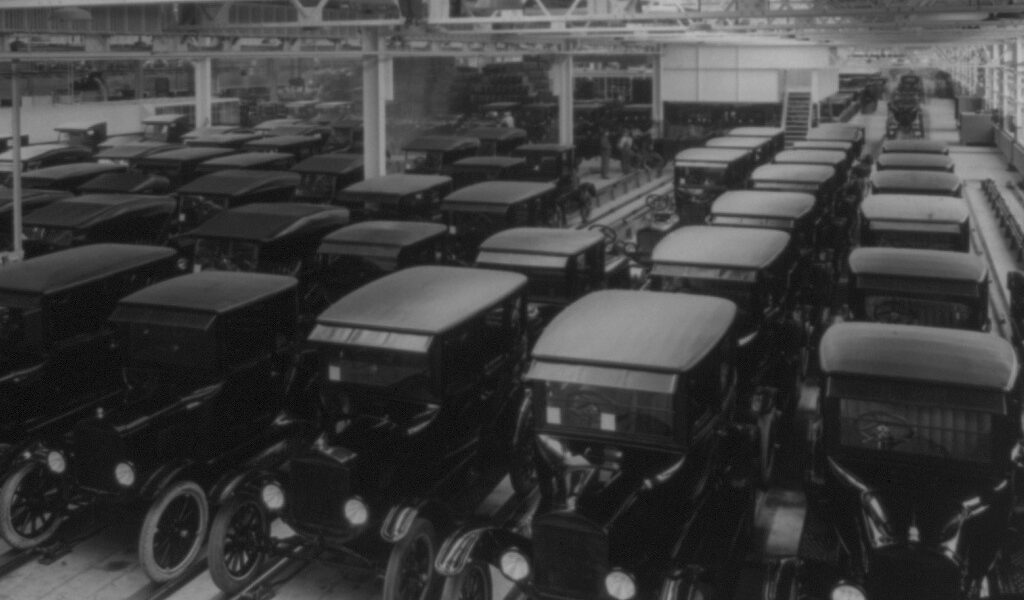
The collapse of the Inspection Era occurred when product complexity increased. Inspecting 100% of production (checking every single unit produced) became physically impossible and economically unviable on ultra-high-speed production lines, such as those of Ford and Western Electric.
Summary of the First Era
| Element | Characteristic in the Inspection Era |
|---|---|
| Main Objective | Defect detection and product classification. |
| Management Role | Supervise inspectors and define tolerances. |
| Responsibility | Exclusive to the Inspection Department. |
| Approach | Reactive (looking at the past / finished item). |
| Advantages | Disadvantages |
|---|---|
| Ensures customers receive functional products | High Cost: Waste was enormous (scrap/junk). |
| Introduces standardization into industry | Late Detection: Errors were only found after raw materials and energy had been consumed. |
| Establishes clear acceptance criteria | Demotivation: Inspectors and workers were often in conflict. |
Although limited, the Era of Inspection left the most important legacy of the discipline: Standardization. Without the ability to measure and compare against a standard (the heart of inspection), the later eras of statistical control and strategic management would have had no foundation to exist.
Transition to the Second Era
In 1924, Western Electric created the Inspection Engineering Department to handle quality-related issues — an organization that would later become the Quality Assurance Department of Bell Laboratories. Among its members were influential figures such as Walter A. Shewhart, Harold Dodge, Harry Romig, G. D. Edwards, and later Joseph Juran, whose collective work laid the foundation for what we now know as statistical quality control — the central pillar of the Second Era of Quality.
The realization that more inspection did not mean better production forced the transition to the Second Era. The logic changed: instead of looking at the defective product, managers began looking at the process that allowed the defect to occur.